

In the dynamic landscape of digital marketing, content remains king, but only if it’s discovered. For tech startups and established businesses alike, a blog is an indispensable tool for establishing authority, engaging audiences, and driving organic traffic. However, simply publishing content isn't enough; the true challenge lies in creating blog posts that not only resonate with your target audience but also climb the ranks of Google's search results. In an increasingly competitive online environment, understanding the nuances of SEO is paramount. This comprehensive guide from Eamped will walk you through the strategic steps and essential tactics needed to craft blog posts that consistently rank high on Google in 2026 and beyond, transforming your content into a powerful lead-generating asset.
Understanding the Foundation: Keyword Research & Audience Intent
Before a single word is typed, the bedrock of a successful, ranking blog post is laid through meticulous keyword research and a deep understanding of audience intent. This isn't just about finding popular terms; it's about uncovering what your potential customers are actively searching for and why. Ignoring this crucial first step is akin to building a house without a foundation – it might look good initially, but it won't withstand the tests of time or Google's ever-evolving algorithms.
Identifying High-Value Keywords
- Broad vs. Long-Tail Keywords: While broad keywords (e.g., "digital marketing") attract high search volume, they are also intensely competitive. Long-tail keywords (e.g., "how to write blog posts that rank on Google for tech startups") are more specific, have lower search volume, but often carry higher conversion intent and are easier to rank for. A balanced strategy incorporates both.
- Keyword Research Tools: Leverage tools like Google Keyword Planner, Ahrefs, Semrush, or Ubersuggest. These platforms provide data on search volume, keyword difficulty, and related terms, helping you identify opportunities. Look for keywords with a decent search volume that aren't overly competitive for your domain authority.
- Competitor Analysis: Analyze what keywords your competitors are ranking for. This can reveal untapped opportunities or confirm the viability of certain topics within your niche. Use competitor analysis tools to see their top-performing content and the keywords driving traffic to it.
- Topical Authority: Instead of focusing on individual keywords in isolation, think about building topical authority. This involves creating a cluster of interconnected content around a broad subject. For instance, if your core topic is "SEO," you'd create pillar content on "What is SEO?" and then supporting articles on "keyword research," "on-page SEO," "link building," etc. This signals to Google that your site is a comprehensive resource on the subject.
Deciphering Search Intent
Google's primary goal is to provide the most relevant results to a user's query. Understanding search intent—the 'why' behind a search—is critical for creating content that truly satisfies users and, consequently, ranks. There are four main types of search intent:
- Informational: Users are looking for information, answers to questions, or general knowledge (e.g., "how to write blog posts," "what is a tech stack"). Your content should be comprehensive, educational, and problem-solving.
- Navigational: Users are trying to find a specific website or page (e.g., "Eamped blog," "Google Analytics login"). While less relevant for blog post creation, understanding it helps differentiate.
- Commercial Investigation: Users are researching a product or service before making a purchase (e.g., "best project management software startups reviews," "CRM comparison"). Your content should provide detailed comparisons, reviews, and buying guides.
- Transactional: Users are ready to make a purchase or take a specific action (e.g., "buy SEO software," "sign up for free trial"). These keywords often lead to product pages or landing pages rather than blog posts, but blog posts can nurture users towards this stage.
By aligning your content with the specific intent of a keyword, you significantly increase its chances of ranking and engaging the right audience. Always ask yourself: "What does the user truly want to accomplish by searching for this term?"
Crafting Compelling Content: Value, Structure, and Engagement
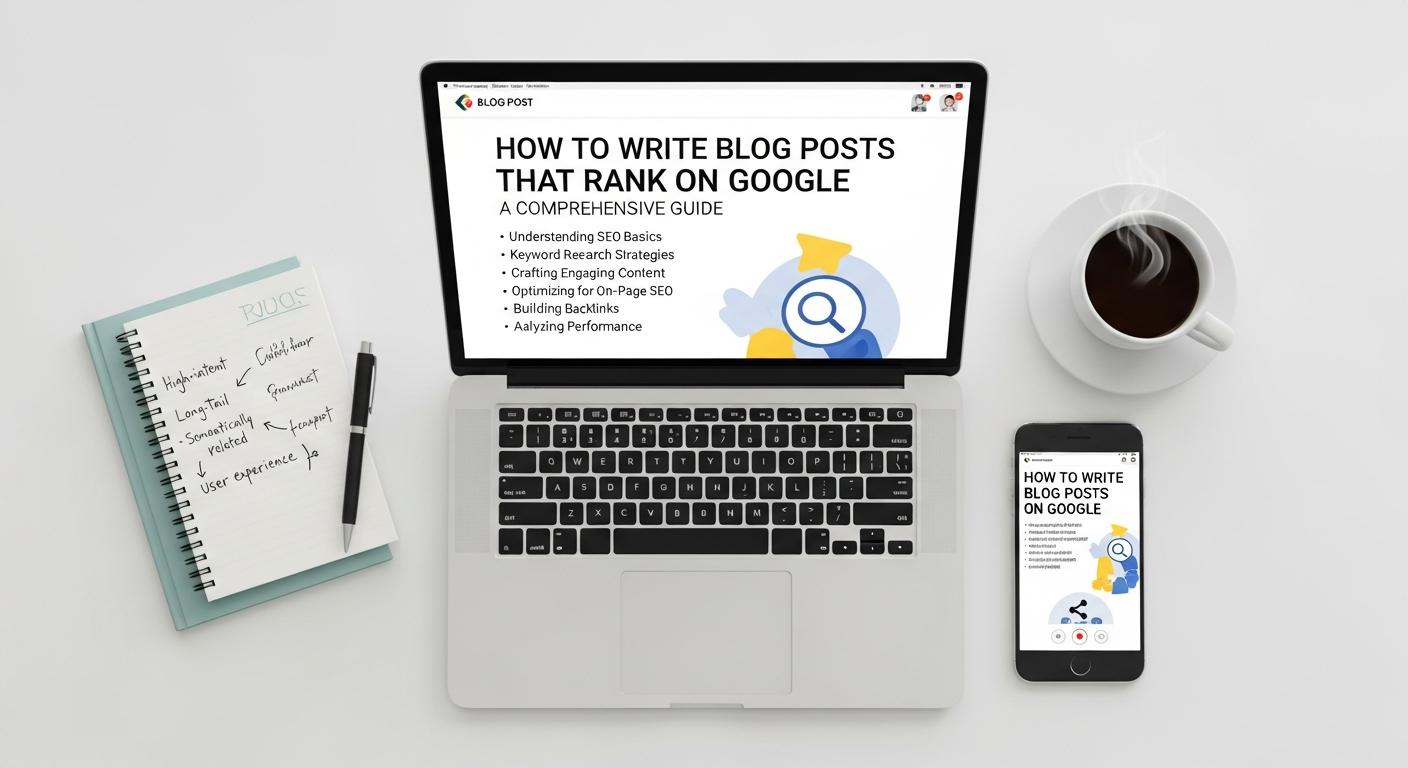
Once you’ve identified your target keywords and understood user intent, the next critical step is to create content that is genuinely valuable, well-structured, and highly engaging. Google's algorithms are increasingly sophisticated, prioritizing content that demonstrates expertise, authoritativeness, and trustworthiness (E-A-T) and keeps users satisfied. In 2026, content quality is not just a differentiator; it's a fundamental requirement for ranking.
Delivering Unmatched Value
- Solve a Problem or Answer a Question: Every blog post should aim to solve a specific problem or thoroughly answer a question for your target audience. If your post on "how to write blog posts that rank on Google" doesn't provide actionable, comprehensive advice, it won't perform well.
- Originality and Depth: Avoid simply regurgitating information already available online. Offer fresh perspectives, unique insights, original research, or detailed case studies. Go deeper than your competitors, providing more comprehensive answers and examples.
- Actionable Advice: Beyond information, provide clear, actionable steps that readers can implement. Practical tips, checklists, and step-by-step guides make your content more useful and memorable.
- Evergreen Content: Strive to create content that remains relevant over time. While some topics are time-sensitive, evergreen content (like "What Is A Tech Stack How To Choose" or guides on fundamental marketing principles) continues to drive traffic long after publication, requiring only periodic updates to remain current, perhaps in late 2026 or early 2027.
Structuring for Readability and SEO
Even the most valuable content will fail to engage if it's a dense wall of text. Structure is key for both user experience and search engine crawlability.
- Compelling Introduction: Hook your reader immediately. State the problem, promise a solution, and clearly outline what the post will cover.
- Clear Headings and Subheadings (H2, H3): Break up your content using logical and descriptive headings. These not only improve readability but also help search engines understand the structure and main topics of your article. Use your target keyword and related terms naturally within these headings. For instance, an
might be "Optimizing Your Blog Post for Technical SEO."
- Short Paragraphs: Aim for 2-4 sentences per paragraph. This makes text easier to scan, especially on mobile devices.
- Bullet Points and Numbered Lists: These are excellent for breaking down complex information, highlighting key takeaways, and presenting steps in a clear, digestible format.
- Visuals: Incorporate relevant images, infographics, charts, and videos. Visuals break up text, explain complex concepts, and increase engagement. Remember to optimize images with descriptive filenames and alt text.
- Concise Conclusion: Summarize the main points and provide a clear call to action (e.g., "subscribe to our newsletter," "check out our services," "read more about what is a tech stack how to choose").
Fostering Engagement
Google considers user engagement metrics (like time on page, bounce rate, and click-through rate) as indicators of content quality. Higher engagement often correlates with better rankings.
- Conversational Tone: Write in a way that feels like you're speaking directly to the reader. Use "you" and "your" to create a personal connection.
- Storytelling: Where appropriate, incorporate anecdotes or real-world examples to make your points more relatable and memorable.
- Interactive Elements: Consider adding polls, quizzes, or comment sections to encourage user interaction.
- Internal Linking: Strategically link to other relevant articles on your blog. This keeps users on your site longer, distributes link equity, and helps Google understand your site's structure. For example, if discussing content promotion, you might link to an article on "what is pay per click advertising" as a complementary strategy.
On-Page SEO Essentials: Optimizing for Search Engines
Once you have stellar content, it’s time to fine-tune it for search engines. On-page SEO involves optimizing individual web pages to rank higher and earn more relevant traffic in search engines. These are the elements you directly control on your page, and mastering them is crucial for any blog post aspiring to rank on Google in 2026.
Title Tags and Meta Descriptions
- Title Tag (<title>): This is arguably the most important on-page SEO element.
- Include your primary keyword naturally, ideally towards the beginning.
- Keep it concise, generally under 60 characters, to avoid truncation in search results.
- Make it compelling and accurately reflect the content.
- Consider adding power words (e.g., "Ultimate Guide," "Proven Strategies") or the current year (2026) for freshness.
- Meta Description: While not a direct ranking factor, a well-crafted meta description significantly impacts click-through rate (CTR).
- Include your primary keyword and secondary keywords.
- Summarize the article's value proposition in about 150-160 characters.
- Make it enticing and encourage users to click.
- Think of it as a mini-advertisement for your blog post.
URL Structure
- Descriptive and Keyword-Rich: Your URL should be clean, concise, and include your primary keyword. Avoid long, cryptic URLs.
- Good example:
eamped.com/blog/how-to-write-blog-posts-rank-google - Bad example:
eamped.com/blog/p=12345&cat=2&date=2026-03-15
- Good example:
- Hyphens for Separators: Use hyphens (-) to separate words, not underscores (_).
- Keep it Short: Shorter URLs are easier to remember, share, and Google generally prefers them.
Header Tags (H2, H3, etc.)
As discussed in content structure, header tags (<h2>, <h3>, <h4>) are vital for both readability and SEO. They provide a hierarchical structure to your content, helping search engines understand the main topics and subtopics.
- Keyword Integration: Naturally weave your primary and secondary keywords into your H2 and H3 tags. Don't force them, but if a keyword fits logically, use it.
- Logical Flow: Ensure your headings follow a logical progression, guiding the reader (and search engine crawlers) through your article.
- One H1 (Implicit): While we are not using an explicit
<h1>in this output as per instructions, conceptually, your blog post title serves as the main topic. All other headings should support this central theme.
Image Optimization
Images can significantly enhance a blog post, but they must be optimized for SEO.
- Descriptive Filenames: Use keywords in your image filenames (e.g.,
how-to-rank-blog-posts-guide.jpg). - Alt Text: Provide descriptive alt text for every image. This text is displayed if the image fails to load and is read by screen readers for visually impaired users. It also provides context to search engines about the image content. Include keywords naturally here.
- Compress Images: Large image files slow down page loading speed, a critical ranking factor. Use tools to compress images without sacrificing quality.
Internal and External Linking
- Internal Links: Link to other relevant pages on your own website. This helps distribute "link equity" throughout your site, guides users to more content, and helps search engines discover new pages. For example, from an article on "how to write blog posts," you might link to one on "what is a tech stack how to choose" if it discusses content management systems.
- External Links: Link out to authoritative, credible sources. This demonstrates thorough research, provides additional value to your readers, and signals to Google that your content is well-researched and trustworthy. Use
rel="noopener noreferrer"for external links for security and SEO best practices.
Keyword Density and Semantic SEO
- Natural Keyword Usage: Don't stuff keywords. Google's algorithms are smart enough to understand the context and synonyms. Focus on using your keywords naturally throughout the content where they make sense.
- LSI Keywords (Latent Semantic Indexing): Include related terms and synonyms. If your article is about "how to write blog posts that rank on Google," you'd naturally use terms like "SEO strategies," "content optimization," "search engine visibility," "organic traffic," etc. This helps Google understand the full breadth and depth of your content.
Technical SEO & User Experience: Beyond the Content
While compelling, optimized content is paramount, even the best article won't rank if your website has underlying technical issues or provides a poor user experience. Technical SEO ensures that search engine crawlers can efficiently access, crawl, interpret, and index your website. User experience (UX) factors, heavily weighted by Google, determine how visitors interact with your site, directly impacting rankings in 2026.
Page Speed and Core Web Vitals
Speed is critical. Users expect fast-loading pages, and Google rewards them. Core Web Vitals (CWV) are a set of metrics that measure real-world user experience for loading performance, interactivity, and visual stability.
- Largest Contentful Paint (LCP): Measures loading performance. Aim for an LCP within 2.5 seconds of when the page first starts loading.
- First Input Delay (FID): Measures interactivity. Aim for an FID of less than 100 milliseconds.
- Cumulative Layout Shift (CLS): Measures visual stability. Aim for a CLS score of less than 0.1.
- Optimization Strategies:
- Compress images and other media files.
- Minify CSS, JavaScript, and HTML.
- Leverage browser caching.
- Use a Content Delivery Network (CDN).
- Choose a reliable hosting provider.
- Minimize server response time.
Mobile-Friendliness
With mobile-first indexing, Google primarily uses the mobile version of your content for indexing and ranking. Your blog must be responsive and provide an excellent experience on all devices.
- Responsive Design: Ensure your website automatically adjusts its layout and content to fit various screen sizes.
- Easy Navigation: Menus and links should be easily clickable with a thumb on mobile devices.
- Readable Fonts: Text should be legible without requiring zooming.
- Google's Mobile-Friendly Test: Regularly use this tool to identify and fix any mobile usability issues.
Site Architecture and Navigation
A logical and clear site structure helps both users and search engines navigate your content efficiently.
- Hierarchical Structure: Organize your content into logical categories and subcategories. This makes it easy for users to find related articles and for Google to understand the relationships between your pages.
- Breadcrumbs: Implement breadcrumb navigation to show users (and search engines) their current location within your site's hierarchy.
- XML Sitemaps: Submit an XML sitemap to Google Search Console. This helps Google discover all the important pages on your site, including new blog posts.
- Clean URLs: As mentioned before, maintain descriptive and consistent URLs.
Website Security (HTTPS)
HTTPS is a minor ranking factor and a critical trust signal. Ensure your entire website, including your blog, uses an SSL certificate. This encrypts data transmitted between the user's browser and your server, protecting user privacy.
Content Management System (CMS) and Tech Stack Considerations
The choice of your content management system (CMS) and overall tech stack can significantly impact your technical SEO capabilities. Platforms like WordPress, HubSpot, or custom-built solutions each have their pros and cons regarding SEO features, plugin availability, and customization.
- When considering what is a tech stack how to choose, prioritize systems that offer:
- Clean code generation.
- Easy meta tag and heading management.
- Built-in or easily integrable SEO plugins.
- Scalability to handle growth.
- Good performance capabilities.
- Ensure your hosting environment supports fast loading times and robust security protocols.
Promotion & Off-Page SEO: Amplifying Your Reach
Writing a fantastic, SEO-optimized blog post is only half the battle. To truly rank high on Google and maximize its impact, you need to actively promote it and build its authority through off-page SEO strategies. This involves getting your content seen by the right people and earning valuable backlinks from other reputable websites, signaling to Google that your content is trustworthy and important.
Social Media Promotion
Share your blog posts across all relevant social media platforms. Don't just post a link; craft engaging snippets, ask questions, and use relevant hashtags to encourage clicks and shares.
- Tailor Content: Adapt your promotional message for each platform (e.g., a visual-heavy post for Instagram, a discussion-starter for LinkedIn, a quick summary for X).
- Consistent Sharing: Don't just share once. Re-share evergreen content periodically with fresh captions.
- Engage with Your Audience: Respond to comments and questions to build community and amplify reach.
Email Marketing
Your email list is one of your most valuable assets. Notify your subscribers whenever you publish a new blog post.
- Segment Your List: Send relevant content to specific segments of your audience for higher engagement.
- Highlight Key Takeaways: In your email, summarize the blog post's main points to entice clicks.
- Call to Action: Always include a clear call to action to read the full article.
Link Building: The Cornerstone of Off-Page SEO
Backlinks from high-authority websites are a powerful ranking signal. They tell Google that your content is credible and valuable enough for others to reference.
- Guest Posting: Write articles for other reputable blogs in your niche, including a link back to your blog post (or relevant page) in your author bio or within the content. This is a mutually beneficial strategy for both content and link acquisition.
- Broken Link Building: Find broken links on other websites and suggest your relevant content as a replacement.
- Resource Pages: Identify websites that curate resource lists and suggest your blog post as a valuable addition.
- Digital PR: Create truly remarkable content (e.g., original research, in-depth studies, viral infographics) that naturally earns media mentions and backlinks. This is particularly effective for tech startups looking to gain industry recognition.
- Influencer Outreach: Collaborate with influencers or industry experts who might share your content with their audience or link to it.
Leveraging Paid Advertising (PPC)
While organic SEO is a long-term strategy, what is pay per click advertising can be a powerful tool to give your new blog posts an initial boost, drive immediate traffic, and gather data.
- Targeted Campaigns: Use platforms like Google Ads or social media ads to target specific demographics or interests that align with your blog post's audience.
- Content Promotion: Run campaigns specifically to promote your highest-value blog posts, especially those designed to attract leads or inform potential customers about your products/services.
- Remarketing: Retarget users who have visited your blog with ads for related content or product offerings.
Monitoring, Analyzing, and Iterating: The Continuous Improvement Loop
Publishing a blog post is not the end of the journey; it’s merely the beginning of its performance lifecycle. To ensure your content consistently ranks and delivers value, you must continuously monitor its performance, analyze the data, and be prepared to iterate and optimize. SEO is not a one-time task but an ongoing process, especially with Google's algorithms evolving regularly through 2026 and beyond.
Essential Analytics Tools
- Google Analytics: This free tool provides invaluable insights into your website traffic, user behavior, and conversions.
- Traffic Sources: Identify where your visitors are coming from (organic search, social, direct, referral).
- Page Views: See which blog posts are most popular.
- Time on Page & Bounce Rate: Gauge content engagement. High time on page and low bounce rate indicate quality and relevance.
- Conversions: Track how many visitors from your blog posts complete desired actions (e.g., newsletter sign-ups, demo requests).
- Google Search Console (GSC): GSC is indispensable for understanding how your site performs in Google Search.
- Search Queries: Discover the exact keywords users are searching for to find your content.
- Impressions & Clicks: See how often your content appears in search results and its click-through rate.
- Ranking Position: Monitor the average position of your blog posts for target keywords.
- Coverage Report: Identify any indexing issues that prevent your content from appearing in search.
- Core Web Vitals Report: Get real-world data on your site's performance.
- SEO Tools (Ahrefs, Semrush, Moz): These paid tools offer advanced features for keyword tracking, competitor analysis, backlink monitoring, site audits, and more detailed insights into your blog post's SEO performance.
Key Metrics to Track
- Organic Traffic: The ultimate indicator of your SEO success. Is traffic to your blog posts increasing over time?
- Keyword Rankings: Are your target keywords moving up in search results?
- Click-Through Rate (CTR): A higher CTR for your snippets in SERPs indicates compelling titles and meta descriptions.
- Time on Page / Engagement: Do users spend a good amount of time consuming your content?
- Bounce Rate: Are users leaving immediately, or are they finding what they need?
- Backlinks: Are your blog posts acquiring new, high-quality backlinks?
- Conversions: Are your blog posts contributing to your business goals (leads, sales, subscriptions)?
Content Refreshing and Optimization
Even evergreen content needs periodic updates to remain relevant and competitive.
- Update Statistics and Facts: Ensure all data, dates, and figures are current (e.g., updating references from 2025 to 2026 or beyond).
- Add New Information: Incorporate new trends, tools, or best practices that have emerged since publication. For example, if a new best project management software startups emerges, you might add it to a relevant comparison article.
- Improve Readability: Re-evaluate structure, add more visuals, or break up dense paragraphs.
- Enhance SEO Elements: Update titles, meta descriptions, and header tags based on new keyword opportunities or ranking data.
- Expand Content: If competitors have more comprehensive articles, consider adding more depth and breadth to your own.
- Address User Feedback: If readers leave comments or ask questions, use that as an opportunity to improve the content.
Competitor Analysis
Regularly analyze the blog posts that are outranking yours. What are they doing better? Are they covering additional subtopics? Do they have more backlinks? Use these insights to refine your own content strategy and identify gaps you can fill.
By establishing a robust system for monitoring, analyzing, and iterating, you transform your blog from a static content repository into a dynamic, performance-driven asset that consistently attracts, engages, and converts your target audience, solidifying your position as an authority in your niche.
Frequently Asked Questions About Blog Post Ranking
How long should a blog post be to rank well on Google?
While there's no single magic number, data from 2026 suggests that longer, more comprehensive articles (typically 1,500-2,500+ words) tend to rank better for competitive keywords. This is because longer content often allows for more depth, better coverage of a topic, and the natural inclusion of more keywords and related terms. However, quality always trumps quantity. Focus on providing thorough, valuable information rather than simply hitting a word count. A shorter, highly focused article can still rank if it perfectly answers a user's query and provides exceptional value.
How often should I publish new blog posts to rank on Google?
Consistency is more important than sheer volume. While some studies suggest that publishing 2-4 times a week can lead to more traffic, the optimal frequency depends on your resources and ability to maintain high quality. It's better to publish one exceptionally well-researched and optimized post per week than five mediocre ones. Google prioritizes quality and relevance. A steady stream of valuable content helps establish topical authority over time and keeps your audience engaged, signaling to search engines that your site is active and updated.
Do social media shares directly impact Google rankings?
Social media shares are not a direct ranking factor for Google. Google has explicitly stated that social signals do not directly influence search rankings. However, social media plays a crucial indirect role. Increased visibility on social platforms can lead to more traffic to your blog post, which in turn can lead to higher engagement metrics (like time on page, lower bounce rate), more brand mentions, and potentially more natural backlinks—all of which are strong ranking signals. So, while not direct, social promotion is an important part of a holistic SEO strategy.
Is it okay to use AI to write blog posts for SEO?
AI writing tools have advanced significantly by 2026 and can be powerful aids in content creation, especially for generating outlines, drafting initial content, or overcoming writer's block. However, relying solely on AI without human oversight often results in generic, less authoritative, or factually inaccurate content. Google's E-A-T (Expertise, Authoritativeness, Trustworthiness) guidelines emphasize human insight and originality. Use AI as a co-pilot to enhance efficiency, but always ensure human editors add unique perspectives, verify facts, refine the tone, and infuse the content with true expertise to make it stand out and rank.
How long does it take for a new blog post to rank on Google?
The time it takes for a new blog post to rank on Google can vary significantly, ranging from a few weeks to several months, or even longer for highly competitive keywords. Factors influencing this include your website's domain authority, the competitiveness of the target keyword, the quality and optimization of your content, and your ongoing promotion and link-building efforts. Newer websites or those targeting very competitive terms will generally take longer. Patience and consistent effort in all areas of SEO are key to seeing results.
Should I update old blog posts, or always create new ones?
It's highly recommended to do both. Regularly updating and refreshing old blog posts, especially those that are evergreen or have declining rankings, can be a highly effective SEO strategy. Updating content (with new data, expanded sections, improved visuals, or better optimization for 2026 trends) can signal to Google that the content is fresh and relevant, often leading to significant ranking boosts with less effort than creating a new post from scratch. Meanwhile, new posts allow you to target new keywords, expand topical authority, and keep your audience engaged with fresh perspectives.
Recommended Resources
Explore Best Budget Smartphones 2026 for additional insights.
Learn more about this topic in Color Theory In Ui Design at Layout Scene.